

How to Find a Carpenter Ant Nest (And What Does a Carpenter Ant Nest Look Like?)
If you’ve spotted large black or reddish-brown ants making their way through your home, there’s a good chance a carpenter ant colony is somewhere nearby. Knowing how to find a carpenter ant nest and understanding what you’re actually looking at is the first step toward protecting your house from serious structural damage.
Carpenter ants are one of the most destructive pest species in Canada. Unlike termites and many other insects, they do not eat wood. They hollow it out to build tunnel systems called galleries. The damage they leave can be just as costly for your house. In Metro Vancouver, where high rainfall and aging wooden structures are common, these ants are a year-round concern that often calls for professional ant control and specialized ant pest control services.
What Does a Carpenter Ant Nest Look Like?
Most people picture a mound of dirt when they think of an ant nest, but a carpenter ant nest looks nothing like that. Instead, it lives entirely within wood — and from the outside, it can be nearly invisible, especially when the carpenter ants indoors remain hidden within walls and ceilings, slowly compromising the house frame.
The Gallery System
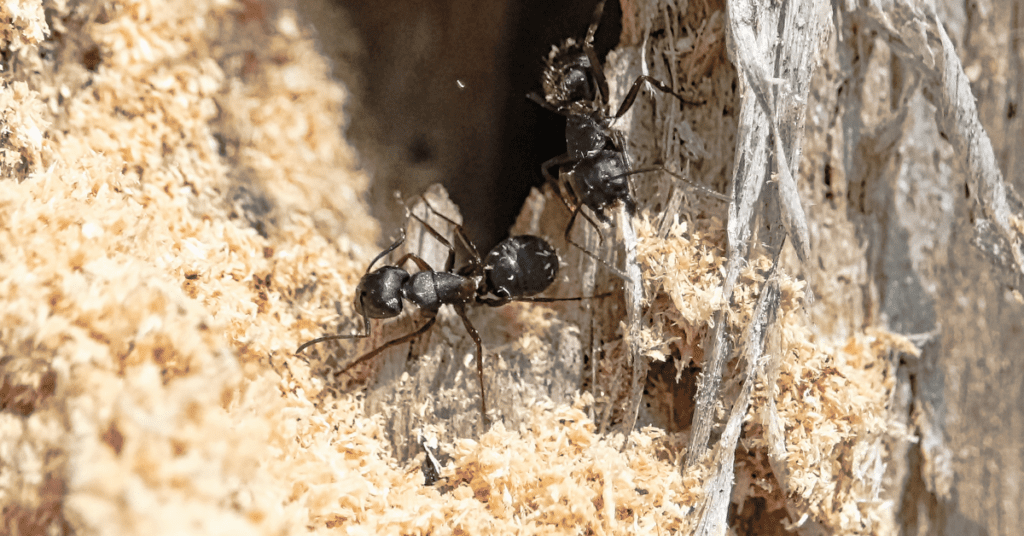
A carpenter ant nest is a network of smooth, clean tunnels carved through wood, collectively known as a gallery. Unlike termite damage, which tends to leave tunnels packed with mud or soil, carpenter ant galleries have polished walls — almost sandpaper-smooth in texture. The ants use their powerful mandibles to chisel through the wood fibre, then expel the debris outside the nest.
That expelled debris is called frass — coarse, sawdust-like shavings mixed with insects body parts and other waste. Frass piles near baseboards, window sills, or door frames are key signs of activity. Frass near wooden beams is also a clear warning. These piles show that a gallery is close by. They are often the first clue of an active carpenter ant infestation.
Parent Nests vs. Satellite Nests
Carpenter ant colonies don’t operate from a single location. They use a two-nest system:
- Parent nest: The original colony, typically established in moist, decaying wood outdoors — in tree stumps, rotting logs, or water-damaged structural wood. This is where the queen lives and where all life stages are present: eggs, larvae, pupae, and adult workers.
- Satellite nests: Secondary colonies that branch off from the parent nest. These are often found indoors, in drier wood, wall voids, hollow doors, or insulation. Satellite nests typically contain only mature larvae, pupae, and workers — no ant queen, no eggs. In some cases, carpenter ant queens may eventually relocate to satellite nests if conditions are ideal, allowing individual ants to expand the overall network of colonies.
This two-nest structure is one reason carpenter ant infestations are so difficult to fully eliminate without professional help. Treating only the satellite nest leaves the parent colony intact and producing more worker ants, as well as other workers that will keep damaging wood.
Signs of Carpenter Ant Nest Nearby
Before you can find the nest, you need to recognize that one exists. Here are the key warning signs to look for — practical tips that homeowners can use during a basic inspection:
You’re Seeing Large Ants Indoors
Carpenter ants are among the largest ant species in Canada, measuring 6 to 25 mm in length. If you’re regularly spotting big black or reddish-brown ants inside your home — especially in kitchens, bathrooms, or along baseboards — there’s likely a colony nearby. Pay close attention to whether these ants have wings. Winged carpenter ants (called swarmers or reproductives) are looking to mate and establish new nests, which means an established colony is already somewhere close. Some homeowners also report painful ant bites when they accidentally disturb an active trail of individual ants.
Frass Piles Near Wood Surfaces
Unexplained piles of coarse, sawdust-like material near wooden surfaces are a strong indicator of carpenter ant activity. Because the ants don’t consume the wood they excavate, this material has to go somewhere. Frass is typically found below or near the entry holes of a gallery — near window casings, door frames, baseboards, or exposed beams.
Rustling or Scratching Sounds Inside Walls
An active carpenter ant colony produces a faint but distinct dry rustling sound as the ants move through their tunnels and excavate wood. This sound is most noticeable at night when the house is quiet and ant activity is at its peak. Health Canada suggests pressing a wine glass or stethoscope against the wall to amplify the sound if you suspect activity.
Hollow-Sounding Wood
Tap on wood surfaces in suspect areas — walls, beams, door frames, or flooring. Wood that has been extensively tunnelled will produce a hollow, papery knock rather than a solid thud. This is a useful field technique that professional pest control technicians use as part of an initial assessment for carpenter ant and other insects activity.
Visible Galleries or Entry Points
In cases of advanced infestation, you may actually see slit-like openings in woodwork or exposed gallery edges. Inside an active gallery, it’s possible to see ants alongside eggs, larvae, and pupae if the colony is well established. The smooth, clean edges of the tunnels distinguish carpenter ant galleries from termite damage, which looks rough and muddy, and may also be filled with dead insects and debris from previous activity.
Steps for Locating a Carpenter Ant Nest
Finding a carpenter ant nest requires a methodical approach. Pest control professionals follow a systematic inspection process that moves from the exterior of the property inward. Here’s how that process typically works:
Step 1: Start Outside
Professional pest control technicians always begin their inspection outdoors. The parent colony is frequently located outside the structure — in tree stumps, rotting fence posts, wood piles, or trees with dead limbs. Key areas to check include:
- Tree branches or shrubs touching the roofline or exterior walls (these act as bridges into the home and can be used by black carpenter ants as well as carpenter ants and other harmful insects)
- Fence lines and railings showing signs of decay
- Log or firewood piles stored near the foundation
- Wooden structures such as decking, porches, or siding that contacts the ground
- Gutters and downspouts where water damage may have softened adjacent wood
Step 2: Follow the Ant Trails
Carpenter ants forage up to 100 metres from their nest and use pheromone trails to navigate. Unlike many ant species, they don’t march in tight, single-file lines — but they do tend to follow consistent paths along edges, such as garden hoses, wall bases, or fence lines. Observing ant movement — especially after sunset, when foraging activity peaks — can lead directly back to the nest entrance. This approach also works for black, ghost, harvester, crazy, and argentine ants. It also helps with field ants, fire ants, acrobat ants, and other species that invade your property.
Step 3: Focus on Moisture-Prone Areas Indoors for Accurate Ant identification
Inside the home, carpenter ants gravitate toward areas with existing moisture problems. Professionals use moisture meters to identify damp zones that may not be visible to the naked eye. High-risk interior locations include:
- Around sinks, dishwashers, and bath traps
- Window sills and door frames (especially where condensation collects)
- Wall voids adjacent to exterior walls
- Below bathroom tiles or near shower enclosures
- Attic spaces with poor ventilation
- Crawl spaces and basement areas near the foundation
Because carpenter ants indoors often nest in hidden voids, careful ant identification is important so that the correct species and treatment method are used. In many cases, knowing the types of carpenter ants present helps determine where nests are most likely to be hidden.
Step 4: Use Advanced Detection Tools to Confirm an Ant Infestation
Professional pest control services go beyond what the naked eye can detect. Thermal imaging cameras can locate hidden nests by detecting heat signatures from ant activity within walls and ceilings. Acoustic detection tools can identify the subtle sounds of an active colony. These tools allow technicians to pinpoint nest locations without tearing open walls unnecessarily and form the basis of many modern carpenter ant control strategies that target carpenter ant colonies more precisely.
Step 5: Account for Multiple Nests
This is where professional expertise becomes critical. Because carpenter ants maintain both parent and satellite colonies, finding one nest doesn’t mean the infestation is over. A thorough inspection maps all active nest sites — indoors and out — before any treatment begins. Treating only the most visible nest while leaving others intact almost guarantees that the infestation will return, so comprehensive ant control planning is essential to prevent a recurring ant problem.
Why Professional Pest Control Is the Right Choice
It’s tempting to try bait stations or over-the-counter sprays when you first spot carpenter ants. These products can knock back the visible population, but they rarely reach the entire colony — especially when satellite nests are hidden inside walls or the parent nest is located in a tree outside. Incomplete treatment does not just leave the problem unsolved. It can cause ants to scatter and move. They may build new nests elsewhere in the structure. This makes a later visit from an ant exterminator harder. It also makes the carpenter ant infestation in your house more complex.
Professional pest control companies bring tools, training, and treatment methods that aren’t available at the hardware store. In Canada, pesticide products used by licensed pest control operators are subject to Health Canada’s Pest Control Products Act, which governs their registration and safe application. Professionals are trained to apply these products precisely — targeting the nest directly rather than just the foraging ants, and combining carpenter ant control with long-term monitoring for insects and other insects.
The Government of Canada notes this about carpenter ants. Once a colony is well established, you must find the nest. Treating the actual nest site is needed for lasting control. If there are satellite colonies, that is not enough. You must also find and destroy the parent colony. Only then will treatment be fully effective. This is why most homeowners rely on a carpenter ant specialist instead of trying to tackle such harmful insects on their own.
The Risk of Doing Nothing About Carpenter Ant Damage
Carpenter ant damage is gradual, which makes it easy to underestimate. Over months and years, tunnelling weakens joists, beams, and support wooden structures — damage that most Canadian home insurance policies will not cover, since infestations are classified as a maintenance issue rather than a sudden accidental event. Catching and treating an infestation early, before structural repair becomes necessary, is almost always far less expensive than waiting, especially when carpenter ants have already infiltrated multiple colonies across the property.
How Pestcheck Can Help
If you’re in Metro Vancouver and you’ve spotted signs of carpenter ants in your home, Pestcheck is your local expert.
As a family-owned business with over 20 years of experience, we have been protecting homes across Metro Vancouver since 2018. Our licensed technicians follow a proven four-step process:
- Inspection — Every service begins with a thorough inspection by a licensed technician who assesses your specific situation.
- Diagnosis — You receive a clear explanation of the infestation, the treatment options available, and recommendations for pest-proofing.
- Treatment — Technicians perform targeted single or multiple treatments based on what’s needed, with progress reports throughout.
- Prevention — Pestcheck doesn’t just eliminate the current infestation; they identify and address the conditions that made your home vulnerable in the first place.
Pestcheck is one of only a small number of pest control companies in Canada to hold both QualityPro and GreenPro certifications. QualityPro — a credential from the National Pest Management Association — is held by just 1.7% of pest control companies in Canada. GreenPro certification means treatments are environmentally responsible, using Health Canada-registered products applied safely around families and pets.
Don’t Let Carpenter Ants Write the End of Your Home’s Story
Carpenter ants are patient, methodical, and surprisingly good at staying hidden — but so are the professionals who know how to find them. The earlier you act on the signs, the less damage you’ll be dealing with down the road.
If this article helped you understand what to look for, share it with a neighbour, a friend with a cottage, or anyone who owns an older home in Metro Vancouver. Carpenter ants are a widespread problem in BC, and the more people know what to watch for, the better protected our homes and communities are.
And if you suspect a nest is already somewhere in your walls, don’t wait for confirmation. Reach out to Pestcheck because the best time to deal with carpenter ants was yesterday, and the second best time is today.